
English| EUR
Suggested for you
More currencies
Choose a language
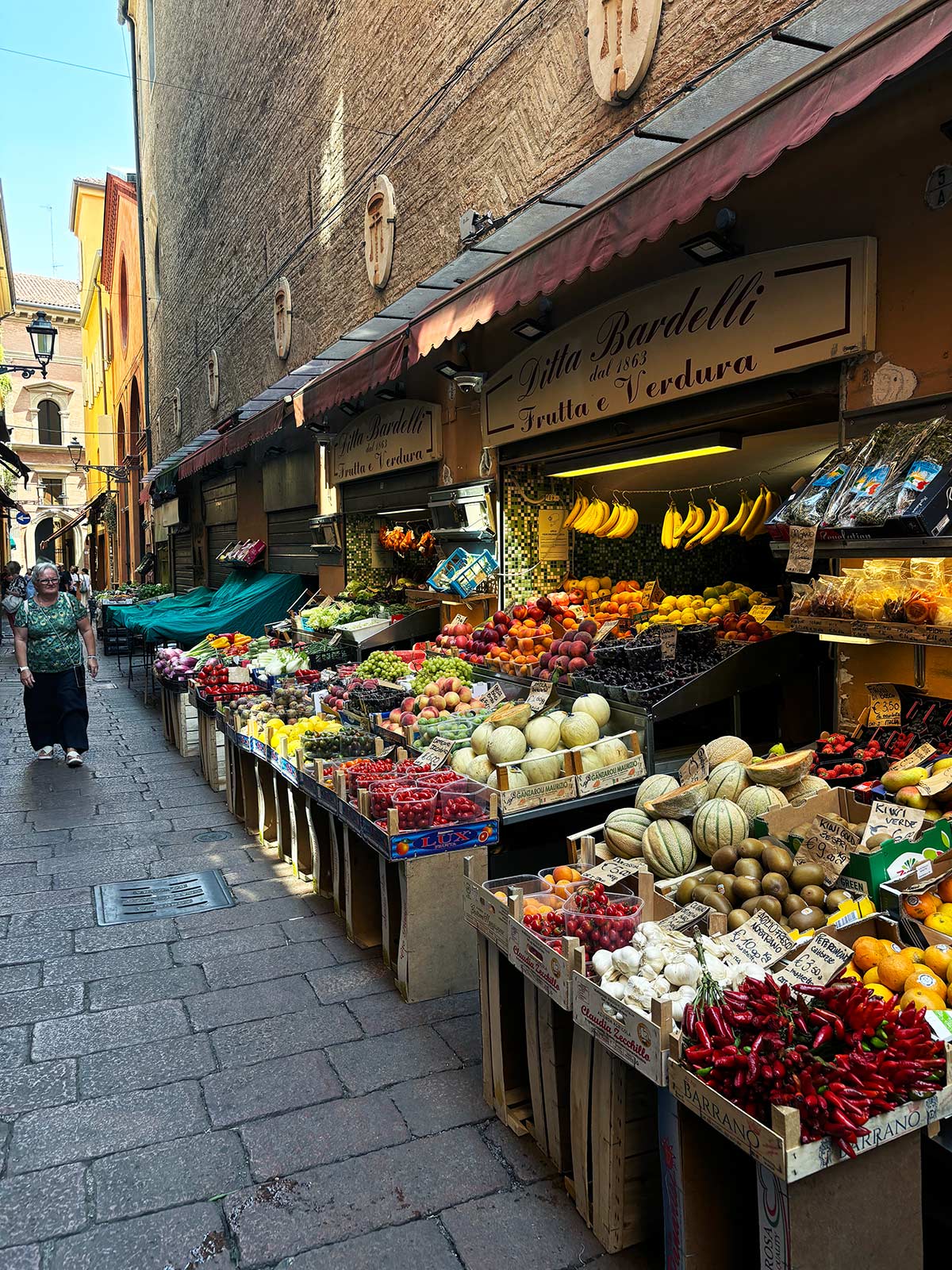
The Quadrilatero, the dense grid of medieval trade lanes east of Piazza Maggiore, is where Bologna still buys its mortadella, tortellini and Parmigiano. Walking it costs nothing, but the timing decides whether you meet full counters or shuttered ones. This page sets out what a self-directed food walk through Bologna actually involves before you commit a morning to it.
Quick answer
A bologna food tour self guided costs 0 EUR to walk: entry to the public markets and streets of the Quadrilatero is free, and you pay only for what you eat. Stalls trade 08:00–19:00 Monday to Saturday and 09:00–19:00 on Sunday. Arrive between 09:00 and 11:00, when counters are fully stocked and the lanes are still passable.
Bologna's food quarter is not a modern invention. The street names in the Quadrilatero are a medieval trade register still in use: Via Pescherie Vecchie for the old fishmongers, Via Drapperie for the cloth sellers, Via Caprarie for the goat traders. The guilds are gone; the counters that replaced them sell the same categories of goods on the same fifty metres of stone. A bologna food tour self guided through this grid is therefore less a route than a reading of an eight-hundred-year-old commercial map. What the reader is dealing with is a compact, high-density block bounded roughly by Piazza Maggiore, Via Rizzoli and Via Farini, containing salumerie, cheese counters, fresh pasta windows, fishmongers and greengrocers within a few minutes' walk of each other. There is no gate, no queue and no ticket desk. That absence of structure is the whole appeal and the whole difficulty. Nobody sequences the visit for you, nobody explains why the tortellini in one window costs three times what it costs in another, and nobody tells you that the pasta laboratories are busiest before lunch while the aperitivo counters only wake at six. A guided Bologna food walk solves this by imposing order. Doing it independently means acquiring that order in advance. The context that makes the timing advice make sense is supply, not crowding alone. Fresh counters in the Quadrilatero are restocked for the morning trade; mortadella is sliced to order, sfoglia is rolled early, and by late afternoon the best of the day has already been sold. Add the mid-day compression of tourists funnelling in from Piazza Maggiore and the case for an early start becomes practical rather than aesthetic. Local practice supports it: the Bolognese shop the market first and eat second. What to do with this is straightforward. Treat the walk as a morning, not an afternoon. Budget cash for small purchases, since several historic counters remain card-shy. Learn three or four target products before arriving — Parmigiano Reggiano, mortadella di Bologna IGP, tagliatelle, balsamico from nearby Modena — so that each stop has a purpose. A well-planned bologna food tour self guided rewards specificity; wandering rewards nobody. Verified hours, the exact arrival window, transport from Bologna Centrale and the venue types worth prioritising are set out in the sections below.
“The guilds are gone; the counters that replaced them sell the same categories of goods on the same fifty metres of stone.”
This route suits independent walkers who prefer to browse at their own speed rather than follow a fixed schedule, and covers roughly three to four hours on foot within the medieval core. Every stop sits within a ten-minute walk of the last, so the sequence can be shortened or reordered without breaking the thread.
Enter the Quadrilatero from Piazza Maggiore and walk the length of this narrow lane, where the fishmongers and produce stalls set out first. Allow 30 minutes to simply look before deciding what to taste.
Turn into the adjoining lanes for the salumerie, cheese counters and pasta windows where sfoglia is rolled in view of the street. Keep to one side — delivery trolleys use these lanes all morning.
Step out of the lanes and cross to the square for a break under the Palazzo del Podestà arcades. A useful reset point if the Quadrilatero feels dense.
Walk ten minutes west to this covered market for a calmer, more local counterpoint to the Quadrilatero's compressed lanes. Budget 45 minutes for a full circuit of the aisles.
Continue north into the quieter grid behind the market, where bakeries and small alimentari sit between residential doorways. Fewer visitors here, and the pace slows accordingly.
Loop back toward the centre along the porticoed main street, stopping where something noted earlier still appeals. Ends within reach of the Due Torri.
Those with energy left can climb toward Via Santo Stefano for its piazza and church complex. Adds about an hour, mostly walking.
The best arrival window for a self-guided food tour is 09:00–11:00. This timing allows you to avoid midday crowds while ensuring market stalls in the Quadrilatero are fully stocked with fresh produce.
Mild, 15°C–22°C; pleasant for walking.
The city is vibrant with comfortable temperatures for navigating the narrow market streets.
Cool, 10°C–18°C; crisp air.
Fall offers ideal conditions for sampling traditional pasta and seasonal truffle dishes.
—
Visiting Tuesday through Thursday during morning hours provides the most relaxed pace for exploring local shops.
Hot, 25°C–32°C; high humidity.
Early starts are essential to beat the afternoon heat and peak tourist volume.
Verdict: Tuesday to Thursday, arriving between 09:00 and 11:00, during the months of April or October provides the most favorable balance of crowd levels and comfortable weather.
The markets within the Quadrilatero district operate on a consistent schedule throughout the week to accommodate self-guided food tours. Most stalls and shops maintain regular daily hours with slightly later opening times on Sundays.
Exploring the food markets and streets of Bologna is an open-air experience with no mandatory admission fees. Costs for a self-guided food tour are determined entirely by the individual purchases made at various stalls and shops.
Verdict: The entry fee is 0 EUR, and total expenditure depends exclusively on the volume and variety of local food products selected.
The Quadrilatero district is located in the heart of Bologna's historic center. Given the restricted traffic zones, walking is the most efficient method to reach the starting point at Via Pescherie Vecchie.
Bologna Centrale to Piazza Maggiore
Lines 11, 20, or 25 to Rizzoli
From Piazza Maggiore via Via dell'Archiginnasio
Drop-off at Piazza Galvani
The best arrival window is 09:00–11:00 to avoid mid-day crowds and ensure market stalls are fully stocked. Access is via pedestrian streets, so plan to arrive on foot from nearby transit hubs.
The culinary landscape of Bologna is defined by its historic artisan workshops and open-air markets concentrated in the city center. Visitors can choose between traditional sit-down eateries or picking up local specialties from street-facing stalls to create their own tasting experience.
market
This ancient grid of streets near Piazza Maggiore houses historic delis and pasta shops where you can purchase regional ingredients. Prices vary by selection
street
A narrow pedestrian thoroughfare lined with stalls offering cured meats, cheeses, and fresh bread for takeaway. Individual item costs apply
restaurant
Small, traditional grocery stores found throughout the side streets that often feature counters for serving wine and meat boards. €€
restaurant
Classic local dining establishments located in the historic core that focus on traditional egg-based pasta dishes. €€€
Navigating the food culture of the Quadrilatero requires understanding local etiquette to ensure a smooth and authentic experience.
When ordering at a counter, take a numbered ticket if one is present, or catch the eye of the counter staff to announce your arrival. Clearly state if you are buying items to go or to eat immediately on-site.
Ask for an assaggio when you wish to sample a small portion of cheese or cured meat before purchasing a larger amount. This is a common practice that helps you confirm the quality and flavor profile you prefer.
Specify the aging of Parmigiano Reggiano by requesting stagionatura options like 24 or 36 months. Vendors appreciate when visitors know the terminology for the specific intensity of flavor they are seeking.
Expect to pay for bread separately in many traditional restaurants and shops, as it is often considered a distinct menu item. Do not be surprised if it is served without butter, as olive oil or balsamic vinegar are the preferred accompaniments.
If you purchase artisanal items to take home, ask the shopkeeper for sottovuoto packaging to ensure your products remain fresh during travel. This vacuum-sealing process is standard for cured meats and aged cheeses intended for transit.
Everything you need to know about bologna food tour self guided
To plan a bologna food tour self guided, start by mapping out the historic Quadrilatero district where traditional artisanal shops are concentrated. Use the official visitor resources to identify authentic local delis and pasta makers before you begin your journey through the city's narrow streets. There is no entrance fee for a bologna food tour self guided as the public markets and streets are freely accessible to all visitors. You simply pay for the individual food items you choose to sample at various stalls and shops. The best arrival window for a bologna food tour self guided is between 09:00 and 11:00 to avoid mid-day crowds and ensure market stalls are fully stocked. Visiting during these morning hours allows you to experience the authentic atmosphere of the market before the peak afternoon rush. Yes, the historic Quadrilatero is the heart of any self-paced culinary exploration, featuring traditional butcher shops, cheese purveyors, and fresh produce vendors. Navigating these stalls allows you to appreciate the variety of local ingredients that define the region's gastronomy. You can certainly explore Bologna culinary landmarks independently, enjoying the freedom to linger at specific storefronts or historic sites. This approach allows you to customize your itinerary based on your personal interests in handmade tortellini or aged balsamic vinegar. While structured excursions offer historical context, many travelers prefer the flexibility of an independent walk to discover hidden bakeries and cafes. Choosing an independent path lets you dictate your own schedule while still experiencing the city's famous culinary heritage.
Vegetarian Bologna Food Tours
Read more Tickets & toursBologna, Parma, and Modena Food Tours
Read more GuideBologna Food Tours: A Local Perspective
Read more GuideBologna Food Tours with Kids
Read more Tickets & toursBologna Food Tour from Florence
Read more Tickets & toursPrivate Bologna Food Tours
Read more Tickets & toursBologna and Parma Food Tours
Read more